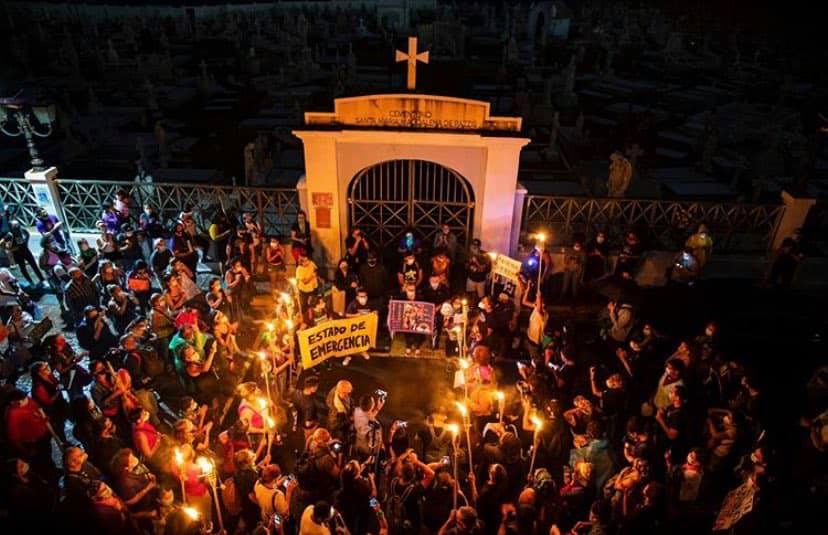
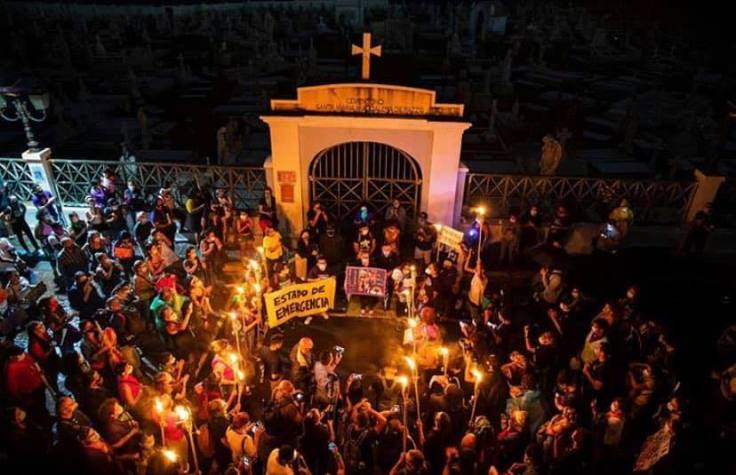
Image from «Colectiva Feminista en Construcción»
By: Génesis Dávila Santiago
09/29/2020
Under the rain and at the edge of dusk, dozens of torches illuminated the left side of the Santa María Magdalena de Pazzi cemetery, in Old San Juan. There, a crowd of people, mostly young people, took to the streets today to demand from the government, once again, a declaration of a state of emergency due to gender violence in the country.
The memory of the women murdered in recent years remained present, especially that of Rosimar Rodríguez Gómez, reported missing on September 17 of this year and whose body was identified this afternoon. Since last night, the suspicion was circulating that the body found was her.
Because of the news, Melody Fonseca, spokesperson for the political organization Collective Feminist in Construction that led the march “Alive We Want Us! For the Grave, the Patriarchy”, with a megaphone in hand, declared her outrage.
“Last night we went to sleep with the news that one more had been murdered… We are still missing so many… For this reason, we convened with anger and pain, knowing that we are vulnerable… It is here, in a cemetery, where the patriarchal and macho state reserves us a space. We refuse,» sentenced Fonseca.
In that same cemetery, lies the body of Mónica Carazo Vergel, a woman murdered by her partner on December 4 of last year.
Her father, Rafy Carazo, stopped in front of the circle of flaming torches that, as a vigil, honored the memory of those killed and lamented the lack of action by the government.
“How long do we have to bear the loss of women and the LGBTTQ community… Not one more, not one less. This must be taken seriously: establish a state of emergency. You don’t have to be part of the (LGBTTQ+) community to know what’s going on,” Carazo expressed.
At about 6:50 p.m., between slogans, they began the course to La Fortaleza.
“If they touch one, they touch all of us.”
“Sister, calm down, here is your herd.”
“¿Where were you when we were being killed?”
These were some of the slogans they chanted while clapping their hands and playing with pots and pans on the way to the Executive Mansion.
On the way, the rain did not stop, but the torches remained lit. This time, due to the intensity of the slogans and the mass movement, the lights symbolized the collective rage for those who are missing.
A woman in a black T-shirt carried a sign on her back that read “If I disappear tomorrow, burn everything.”
The cobbled streets of San Juan seemed to keep a memory of the times when the claim against gender violence led feminist groups to march, and even spend the night, along those streets almost two years ago.
Today’s march, “Alive We Want Us! For the Grave, the Patriarchy” was the continuation of the claim that began in the demonstration of Plantón N23, in November 2018, when feminist organizations convened by the Feminist Collective in Construction, demanded that Governor Ricardo Rosselló Nevares sign an executive order to declare a state of emergency due to gender-based violence in the country. That year ended with 23 femicides.
A year ago, they took to the streets again, and, today, —due to the inaction of the authorities almost two years later— that demand remains on their lips with the same force that it began. This time, the number of murdered women rise to 35, including Rosimar Rodríguez Gómez. According to the latest update from the Gender Equity Observatory, 14 women remain missing.
Today, Safe Abortion Day, many protesters wore green scarves to remember, along with their struggle, the difficulties faced by women in the country to assert their rights.
On Fortaleza Street, which many have also called “Resistencia” since the summer of 2019, a young woman dressed in green held a banner of the same color that read «Justice for Rosimar, justice for Alexa,» also referring to Alexa Negrón Luciano, the transgender woman murdered on February 24 of this year.
Another young man walked through the crowd yelling “alcohol” and spraying those who reached out. Immediately, he added: «We go out into the street, but we are going to protect ourselves.»
Most of the people wore their masks; a reminder that the pandemic continues to be a threat to all people.
There, Zoán Dávila, a member of the Feminist Collective in Construction, began naming the disappeared and murdered women in Puerto Rico this year. For each name, the crowd responded:
“Here.”
When naming Rosimar Rodríguez Gómez, a slogan took over the place:
«Rosimar is here, the rage is felt».
Meanwhile, with the disappeared women, Dávila made her commitment clear:
“We are going to continue in the streets until they return home.”
A Spanish version of this story was published in Todas
 genesisndavila.com
Deja un comentario